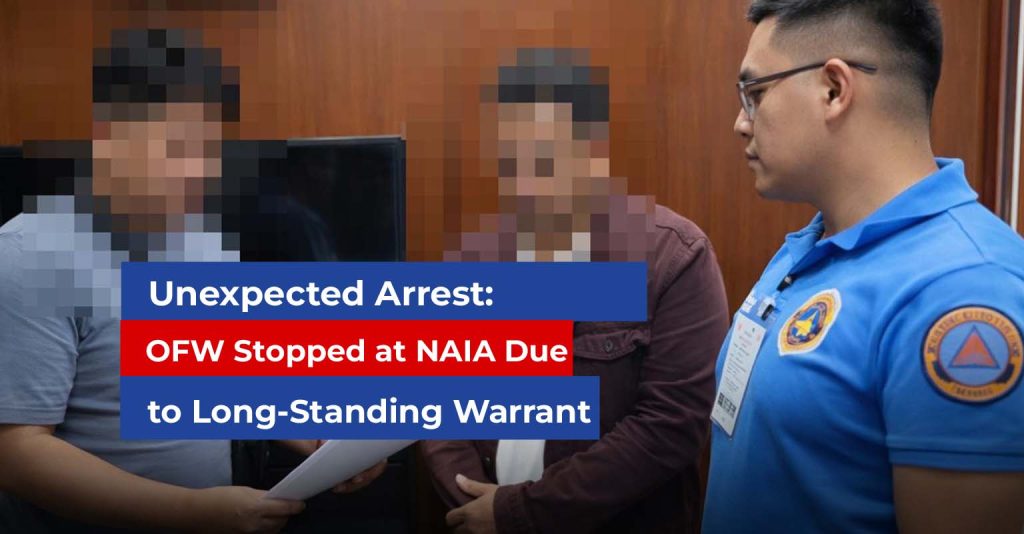
Unexpected Arrest: OFW Stopped at NAIA Due to Long-Standing Warrant
Unexpected Arrest: OFW Stopped at NAIA Due to Long-Standing Warrant Of Arrest
Manila, Philippines — An overseas Filipino worker (OFW) was unexpectedly arrested at Ninoy Aquino International Airport (NAIA) after immigration authorities discovered a long-standing arrest warrant against the individual, officials confirmed.
According to airport and law enforcement sources, the OFW was undergoing routine immigration processing when the system flagged an outstanding warrant issued years earlier in connection with a criminal case filed in the Philippines. The nature of the case and the court that issued the warrant were not immediately disclosed.
Authorities said the individual expressed shock upon being informed of the warrant, claiming to be unaware of any pending legal case. The OFW had reportedly returned to the country for personal reasons after working abroad for several years.
Immigration officials coordinated with the Philippine National Police (PNP), who took the individual into custody at the airport. The suspect was later transferred to the appropriate detention facility to face the charges.
Legal experts note that arrest warrants remain enforceable regardless of how much time has passed unless officially lifted by the court. They also reminded Filipinos working abroad to verify their legal records, especially before returning home.
The incident has renewed calls for better public access to court records and legal assistance for OFWs, many of whom may be unaware of unresolved cases filed before their departure from the country.
Investigations are ongoing, and authorities said further details will be released once verified.
Legal Explainer: What OFWs Should Know About Arrest Warrants and Immigration Checks.
1. Arrest warrants do not expire automatically In the Philippines, an arrest warrant remains valid until it is either served, recalled, or quashed by the court. Even if a case was filed many years ago and the individual has been working abroad, the warrant can still be enforced upon return to the country.
2. Immigration systems are linked to law enforcement databases At major entry points like NAIA, Bureau of Immigration (BI) systems are coordinated with law enforcement agencies such as the Philippine National Police (PNP). During routine arrival or departure checks, a passenger’s name may be flagged if there is an outstanding warrant or active court order.
3. Claiming “no knowledge” of the case does not prevent arrest Even if a returning OFW is genuinely unaware of a pending case or warrant, authorities are legally required to implement the warrant once confirmed. Issues such as lack of prior notice or mistaken identity must be raised later through legal proceedings, not at the airport.
4. What happens after an airport arrest Once a warrant is confirmed:
Immigration authorities turn the individual over to the PNP
The person is brought to the court that issued the warrant or to a detention facility
Bail may be posted if the offense is bailable, subject to court approval
5. How OFWs can check their legal status before returning home Legal experts advise OFWs to:
Consult a lawyer or the Public Attorney’s Office (PAO) to check court records
Ask trusted relatives to verify any past cases filed in local courts
Address unresolved legal issues before traveling back to the Philippines, if possible
6. Importance of legal assistance OFWs who suspect they may have unresolved cases are encouraged to seek legal advice early. Courts may allow motions to recall warrants, especially if the accused is willing to face the case voluntarily and comply with legal requirements.